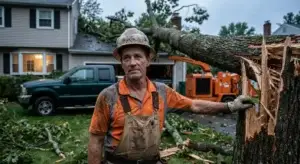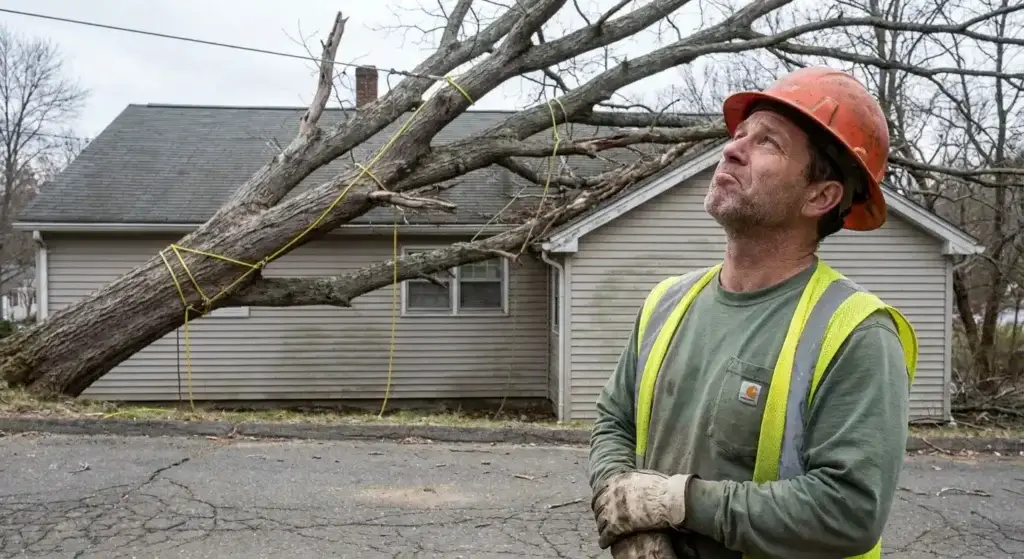
Hazardous tree removal is what happens when a tree stops being a tree and starts being a liability, and here in Hartford and Litchfield County that call usually comes after the wind picks up on a Sunday night. A homeowner walks outside Monday morning, looks up, and realizes the big oak over the garage is not standing the way it was standing last week. That is the moment where the wrong crew, working the wrong way, turns a bad situation into a broken roof.
At Webb Tree Services we get those calls constantly across Canton, Avon, Simsbury, Granby, Farmington, Torrington, New Milford, Litchfield, and everywhere in between. Some of them are true emergencies. Some of them are trees that have been quietly dying for two years and the owner finally noticed. Either way, the question is the same: is this a normal removal, or is this a crane job?
Which Trees Actually Count as Hazardous in Connecticut
Not every ugly tree is a dangerous tree. A hazardous tree, in the way an arborist uses the word, is a tree with a structural defect AND a target it can hit. No target, no hazard, just an ugly tree in the woods. Here is what we flag on a walk-through in Hartford County or Litchfield County:
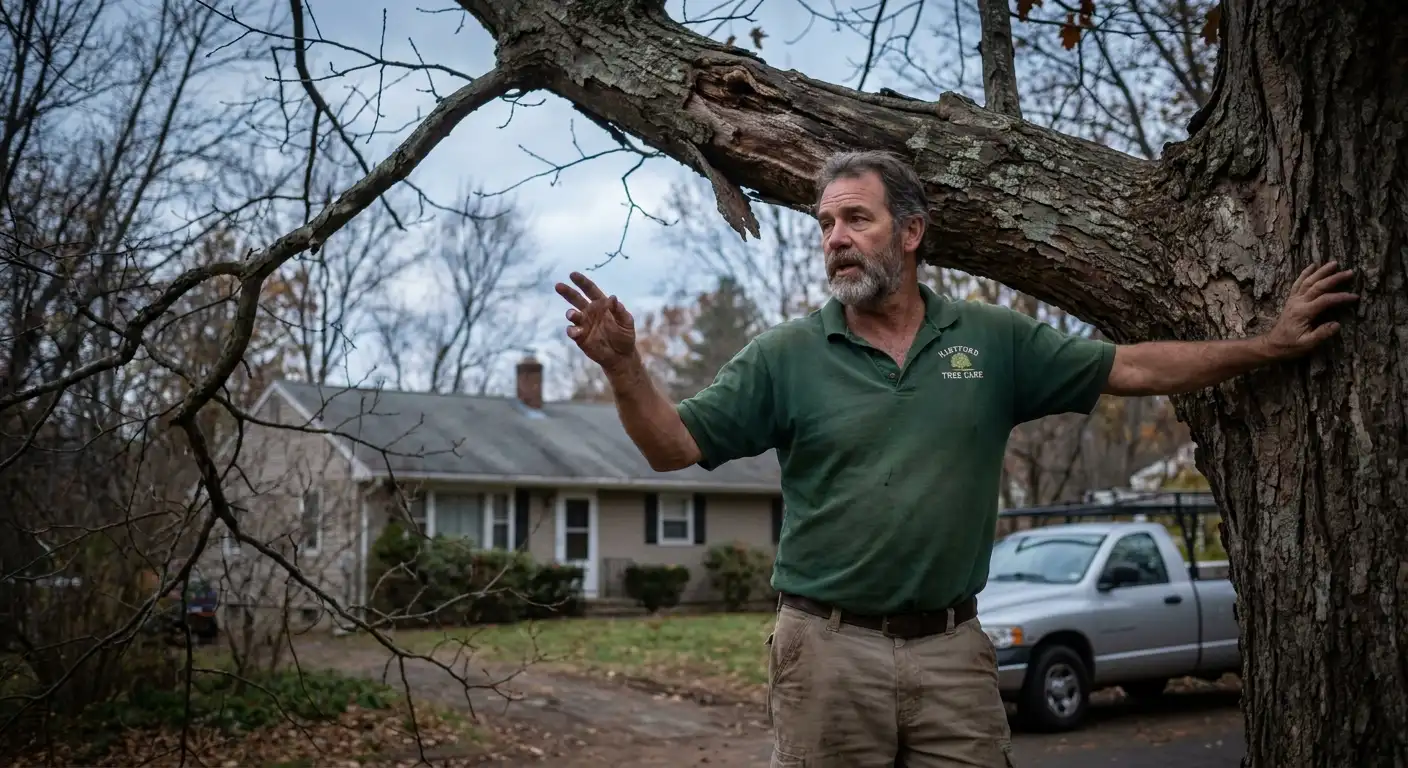
- Dead standing trees, especially white ash killed by emerald ash borer, red oaks lost to gypsy moth defoliation cycles, and older white pines with dead tops. Dead wood does not bend, it snaps. A live tree flexes in a storm. A dead one shatters.
- Split or cracked trunks and major leaders, often from ice load in February or a lightning strike the owner never noticed. Once the wood fibers are separated, the tree is on borrowed time.
- Trees leaning over the house, particularly ones where the lean is new or getting worse. A slow lean over ten years is usually just phototropism. A lean that appeared after a wet nor’easter is a root plate failure and it is not stopping.
- Trees hung up in power lines, either grown into the primaries or dropped into them by a storm. This is never a homeowner DIY and it is not a job for a crew that does not have the utility relationship figured out.
- Trees over pools, septic fields, wells, or propane tanks. Anything that costs five figures to repair if a limb lands on it counts as a target, and the tree above it counts as hazardous.
- Hollow or heavily decayed trees, especially old sugar maples along stone walls in Litchfield County. If a mallet strike sounds like a drum instead of a thud, the trunk is compromised.
Why Climber-and-Rope Removal Gets Dangerous on These Trees
Standard tree removal, the kind most crews do every day, is a climber up in the canopy with a saddle, a rope, and a chainsaw, cutting pieces and lowering them on rigging lines. It works on healthy trees in reasonable spots.
It stops working, and starts getting people hurt, the second any of the following is true:
- The wood the climber has to tie into is dead or rotten. Rigging depends on the anchor point holding. Dead wood does not hold.
- The tree is leaning the wrong direction and every piece cut off makes the lean worse.
- The drop zone is a roof, a pool, a driveway with vehicles, or a septic tank cover. Rigged pieces swing, and a swinging 400-pound log inside a 20-foot rope arc will find whatever you were trying to avoid.
- The tree is hung up in another tree, or in wires, and there is nowhere clean to lower to.
This is where a lot of contractors either walk away from the job, quote it at a number designed to make you walk away, or, worse, take it on and hope. Hope is not a removal plan. That is where our crane comes in.
How an Owned Crane Changes Hazardous Tree Removal
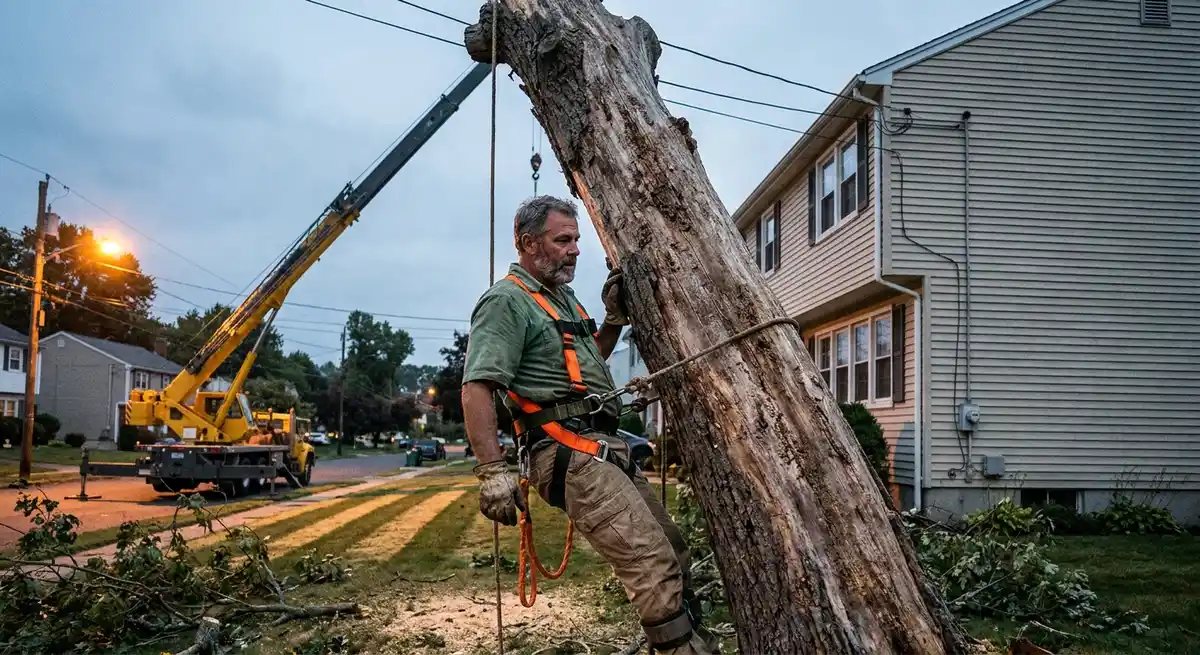
Webb Tree Services owns our crane. We do not rent it, we do not sub it out, we do not wait three weeks for a rental window. That matters for two reasons. First, when the phone rings at 6 a.m. after a storm rolled through Simsbury, the crane is on our lot and ready. Second, because it is our machine, our operator has thousands of hours in the seat and knows exactly what it can pick and where.
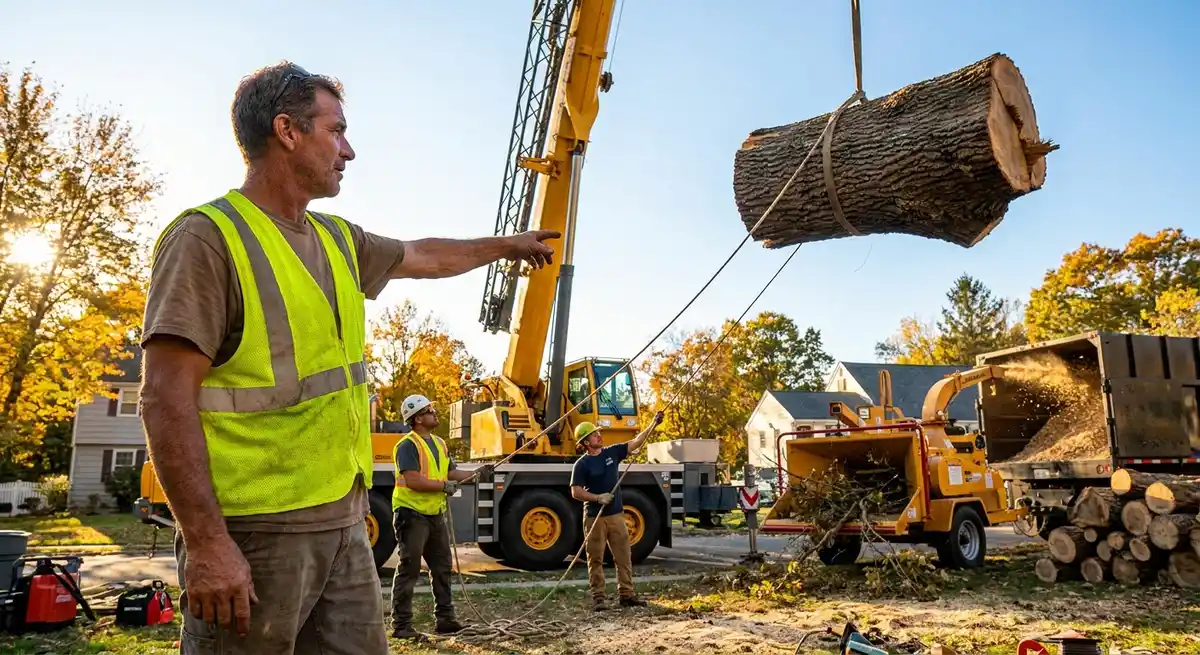
Here is how a crane job on a hazardous tree actually runs. The crane sets up in the safest position, usually the driveway or the yard. The climber goes up (or on a bigger crane pick, gets lifted up in a basket) and chokes a rigging strap around the section to be cut. The crane takes the tension, holding the piece with no slack. The climber makes the cut. The crane picks the piece straight up, swings it over the house, the pool, the septic, whatever the target was, and sets it down gently in the drop zone. No swing. No shock load. No hope.
Piece by piece the tree comes down in a controlled sequence, top to bottom, with the crane doing the heavy lifting and the ground crew feeding pieces to the chipper. A tree that would have been a five-day, high-risk climb becomes a one-day, low-risk lift. That is the difference between the tree being on your roof and the tree being in a chip truck headed off your property.
What Matters When You Hire Someone for This Work
Hazardous tree removal is not the job to pick the cheapest quote on. Three things to verify before anyone starts a saw on your property:
- Actual credentials. Ask for a certified arborist, not a guy who has been “doing trees a long time.” Matt Webb holds a degree in Arboriculture and Landscape Management from Paul Smith College. That is not the same as a season of learning on someone else’s crew.
- Real insurance, in writing. $2M liability plus workers comp is the floor for anyone touching a hazardous tree in Connecticut. If the crew is not insured and one of them gets hurt on your property, the exposure lands on your homeowner’s policy. The Tree Care Industry Association publishes guidelines on what to require from a contractor before work starts, and they are worth reading before you sign anything.
- The right equipment on their lot, not on a rental list. If the job needs a crane and the contractor is calling a crane company to sub it, your timeline is at their mercy and their operator is not tree-trained.
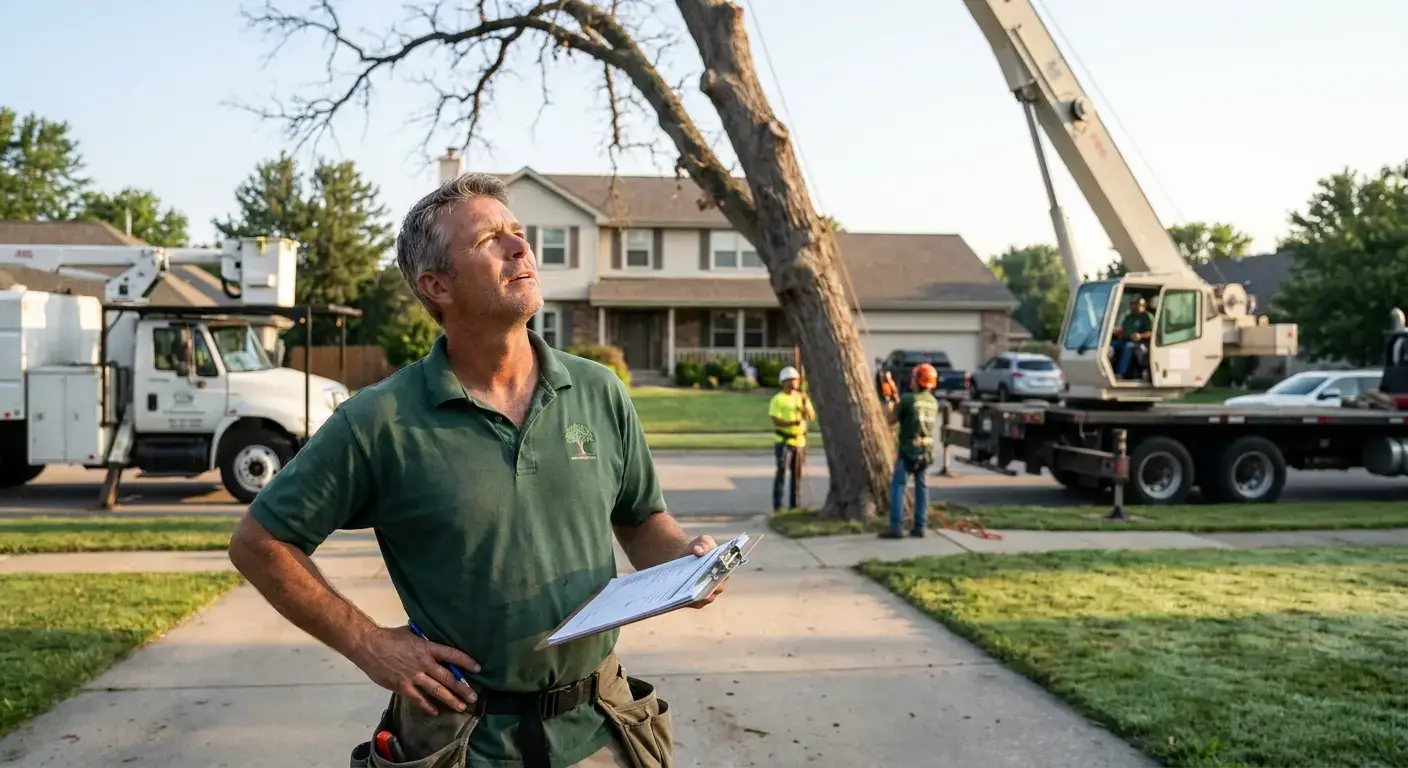
The way a tree service shows up in your driveway tells you almost everything. A clean truck, a chip truck, a crane on a lowboy, a crew in matching shirts, and a foreman who walks the job before saws fire up is a crew that has done this before.
What We Have Done
We have removed over 1,000 trees across Connecticut. We have taken down 37 large white pines in a single day for one homeowner. On hazardous calls the pattern is the same: the tree usually looks worse than the homeowner realized, the crane makes the removal safe, and the property is clean when we leave.
Get a Free Estimate from a Certified Arborist
If you have a tree you are worried about, in Canton, Avon, Simsbury, Granby, Farmington, Burlington, West Hartford, Bloomfield, Torrington, New Milford, Litchfield, or anywhere across Hartford and Litchfield County, get it looked at before the next storm makes the decision for you. Estimates are free. A quick photo texted to us is usually enough to know whether it is a routine removal or a crane job.
Call Webb Tree Services at (860) 839-2760 or email Matt@webbtreect.com. Certified arborist. Owned crane. $2M insured. 24/7 for real emergencies. Left clean, every time.