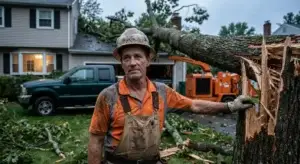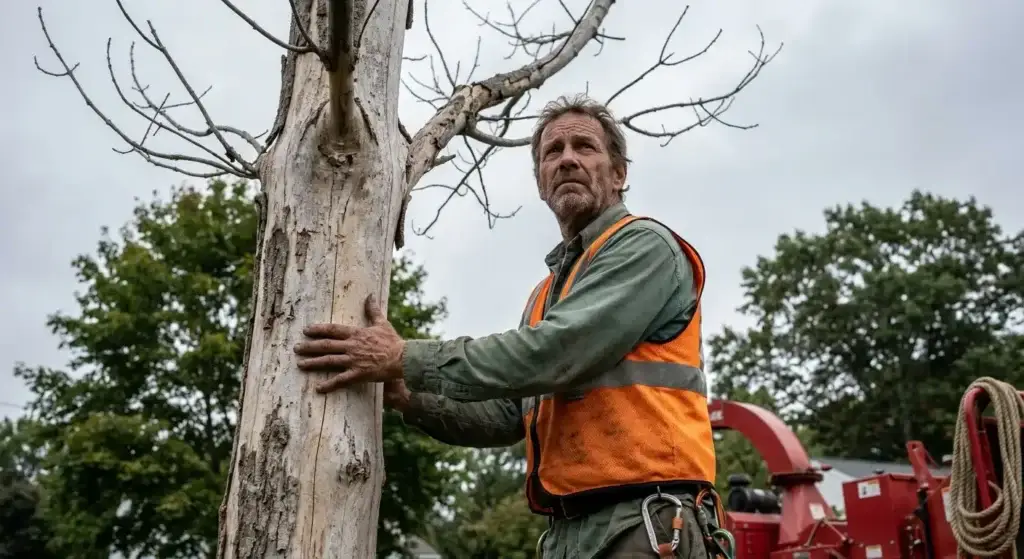
Dead ash tree removal is one of the most urgent calls we get across Hartford and Litchfield County right now, and there is a reason for that. The emerald ash borer, a small metallic-green beetle from Asia, has quietly killed enormous numbers of ash trees across Connecticut over the last decade. If you own property in Canton, Avon, Simsbury, Torrington, or anywhere in between, you almost certainly have a dead or dying ash somewhere on it, whether you have noticed it yet or not.
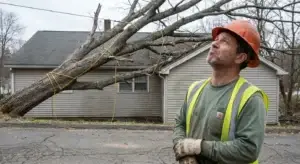
The problem is not that the tree is dead. The problem is what a dead ash does after it dies. Ash wood goes brittle faster than almost any other hardwood in New England. A red oak can stand dead for years and still hold a climber. A dead ash can drop a limb the size of a car onto your roof with no warning, in no wind, on a calm Tuesday afternoon. That is why waiting is the single most expensive decision a homeowner can make with one of these trees.
What the Emerald Ash Borer Actually Does to a Tree
The emerald ash borer, or EAB, does not kill the tree by eating the leaves or boring into the trunk in a way you can easily see. The adult beetles lay eggs in bark crevices, and the larvae tunnel underneath the bark, feeding on the phloem, the layer that moves sugars and water through the tree. Those winding S-shaped tunnels, called galleries, cut off the tree’s plumbing. Within two to four years of infestation, the ash is functionally dead, even if it still looks alive from a distance.
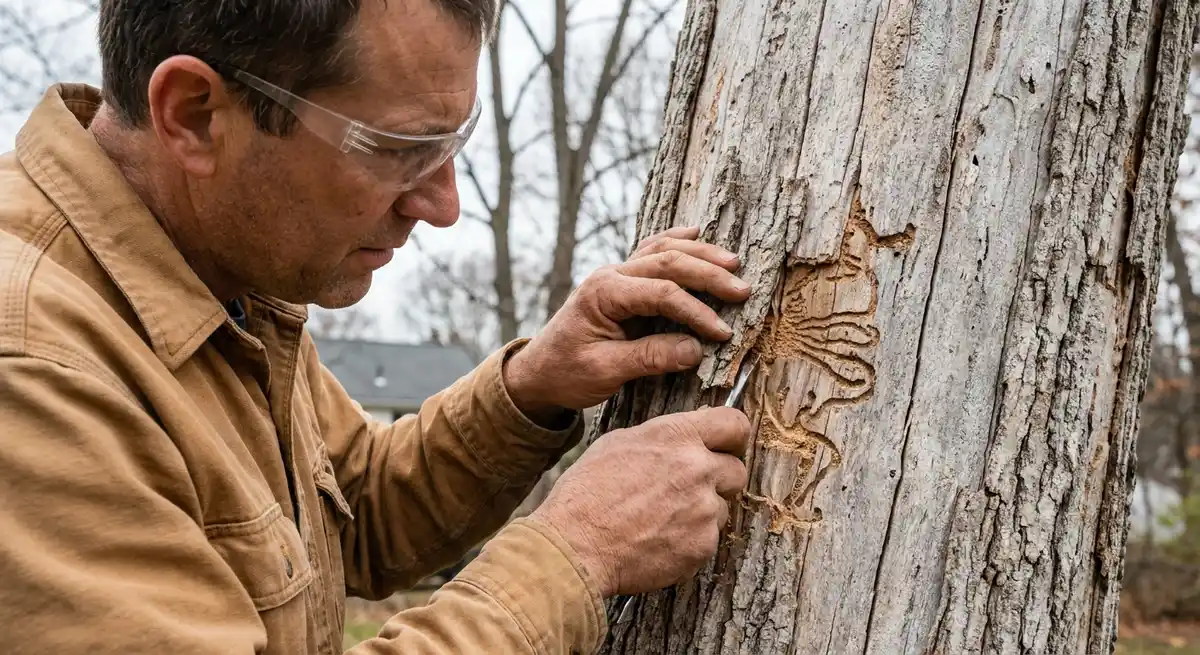
Connecticut has been dealing with EAB since 2012, when it was first confirmed in Prospect. Since then, according to the Connecticut Department of Energy and Environmental Protection, the beetle has spread to all eight counties and killed millions of ash trees statewide. In practice, that means almost every mature ash on a residential property in our service area is either already dead, actively dying, or about to be.
How to Spot a Dying Ash on Your Property
You do not need to be an arborist to recognize the signs. Walk your property this week and look at any ash trees you own. Here is what to look for:
- Canopy dieback from the top down. Ash trees killed by EAB die from the top and work their way down. If the upper third of the canopy is bare while the lower branches still have some leaves, that is EAB until proven otherwise.
- Bark splitting and blonding. Vertical cracks in the bark and pale patches where woodpeckers have chipped bark away to get at the larvae. Woodpecker activity on an ash is a dead giveaway.
- D-shaped exit holes. About one-eighth of an inch across. If you see these on the trunk or larger branches, adult beetles have already left the tree.
- Epicormic sprouts. Clusters of small shoots coming straight out of the trunk or major limbs. This is the tree trying to save itself, and it is a bad sign.
- Sudden loss of small branches. Twigs and small branches littering the ground under an otherwise-standing tree.
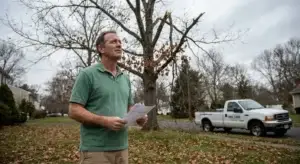
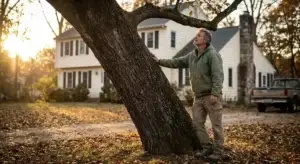
How do you know it is an ash in the first place? Ash trees have opposite branching, meaning branches come off the trunk in matched pairs directly across from each other. They have compound leaves with five to nine leaflets, and mature bark forms a distinctive diamond-shaped pattern when the tree is healthy. If you are not sure, a certified arborist can identify it in about thirty seconds on a free estimate visit.
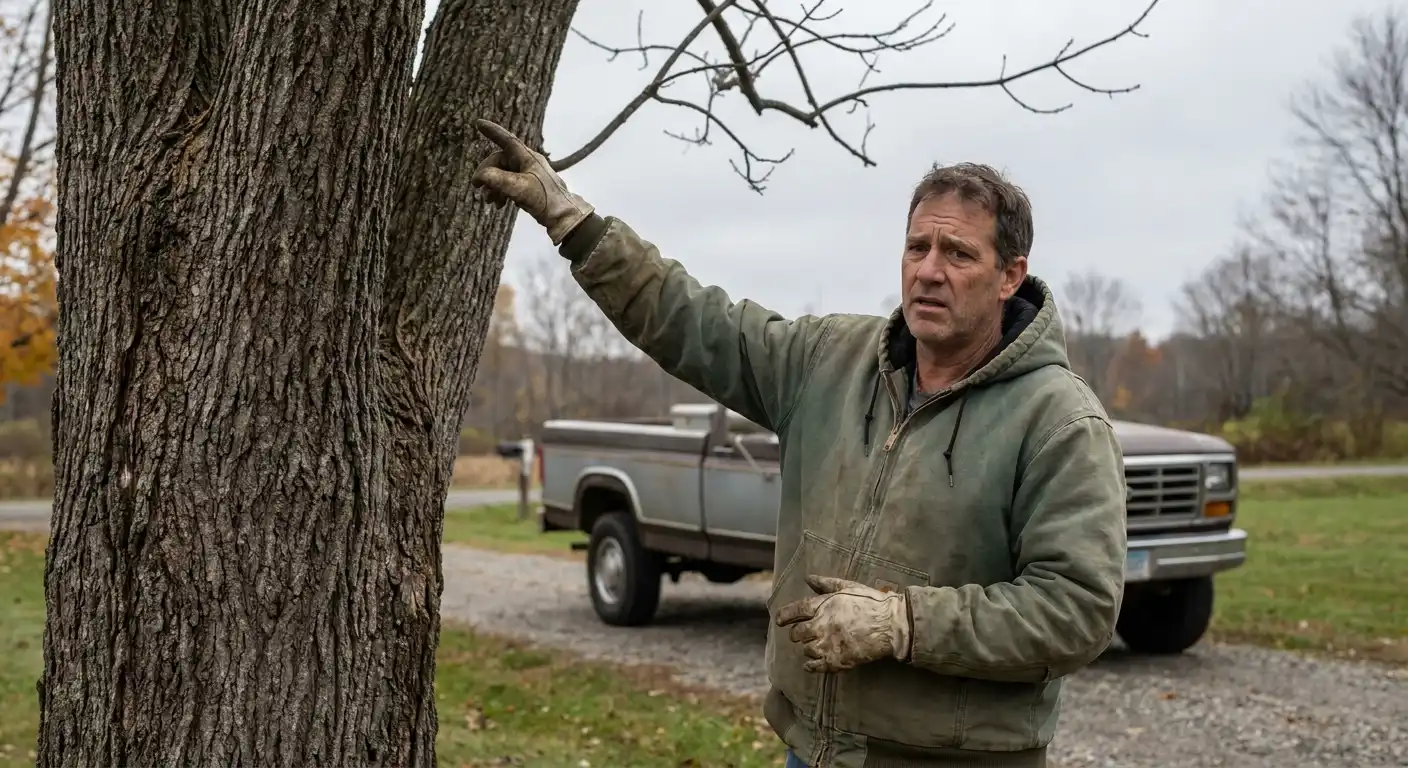
Why Dead Ash Tree Removal Gets More Dangerous the Longer You Wait
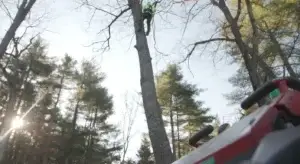
This is the part homeowners underestimate. Once an ash is dead, the wood begins to lose its structural integrity almost immediately. Within eighteen months of death, the tree becomes what climbers call unsafe to climb. What that means in plain English is that no responsible arborist will send a person up that tree with spikes and a rope. The limbs cannot be trusted to hold a climber’s weight, and the trunk cannot be trusted to hold a rigging line under load.
That leaves two options. The first is bucket truck access, which works if the tree is close to a driveway or road and the terrain cooperates. The second, for tight-access properties or trees leaning over a house, is a crane. A crane picks the tree apart from above without anyone climbing it, and it does so in a controlled way that protects the structure below. It is the safe, professional answer for dead ash tree removal in almost every backyard scenario in Hartford and Litchfield County.
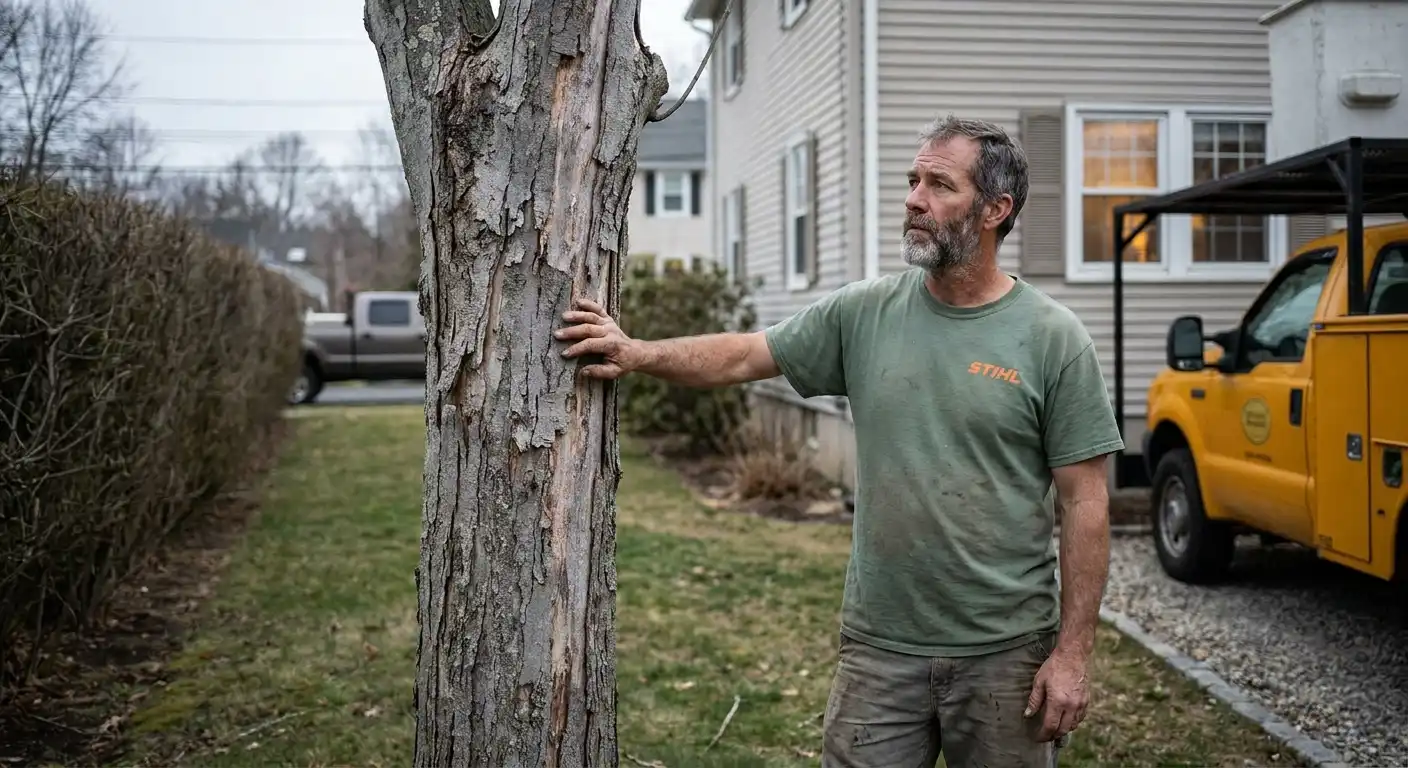
Here is the catch. The longer you wait, the more the tree deteriorates, and the more expensive and complicated the removal becomes. A tree that could have been taken down conventionally last year may need a crane this year. A tree that needed a crane this year may need a crane plus additional rigging and ground protection next year. And in the worst cases, waiting until a storm drops half the tree on your roof turns a scheduled removal into an emergency call with an insurance claim attached to it.
The Insurance Reality Nobody Talks About
Homeowners’ insurance policies in Connecticut increasingly include language about known hazards. If you have a visibly dead ash leaning toward your house and it comes down in a storm and damages the roof, your carrier may deny the claim on the grounds that you knew or should have known the tree was a hazard. We have seen this happen. A five thousand dollar removal today is cheaper than a fifty thousand dollar roof repair that your insurance refuses to cover.
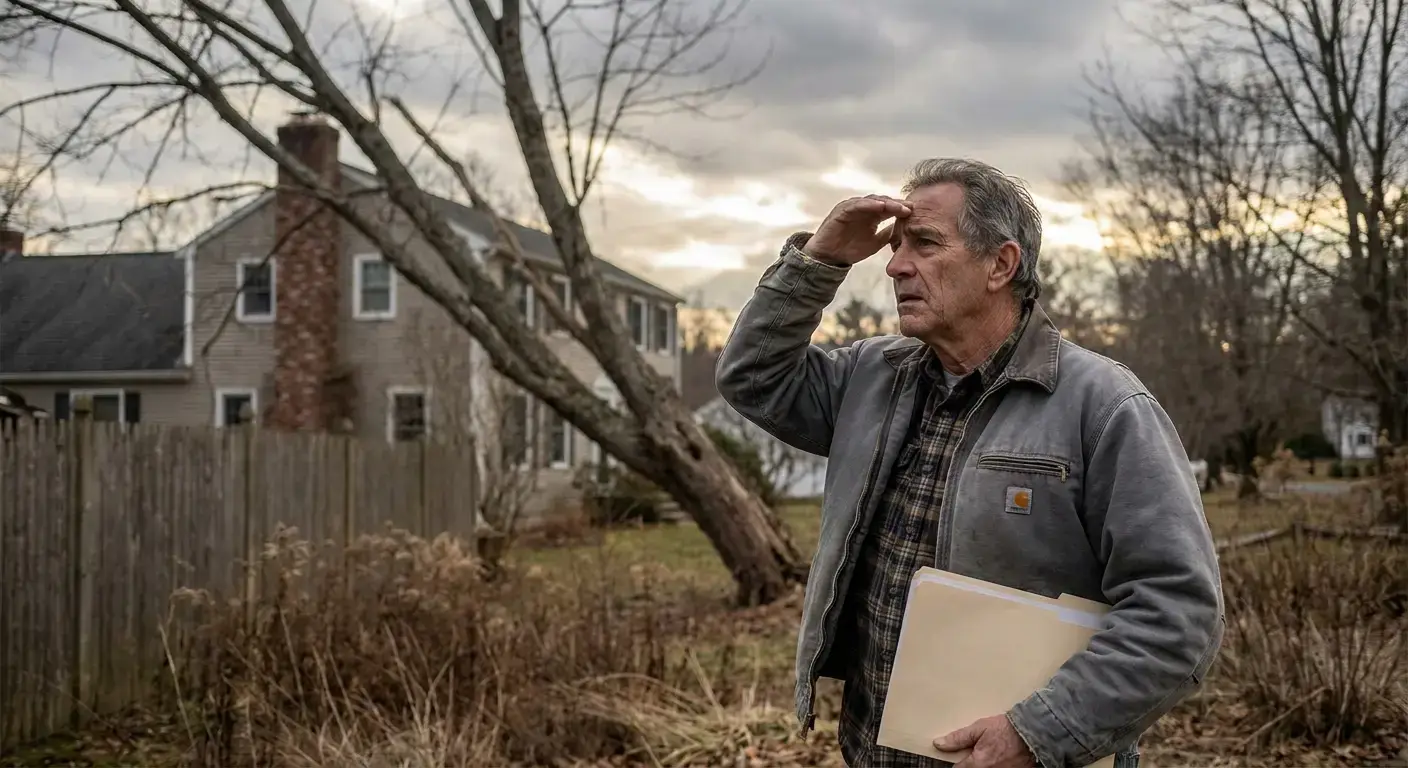
What a Proper Dead Ash Removal Looks Like
When we come out for a free estimate, we walk the property, identify every ash on it, and give you a written scope for each one. For a crane-assisted job, that includes where the crane sets up, how we protect your lawn and driveway, how we section the tree from the top down, and where the wood and brush leave the site. Ground protection mats go under the crane outriggers. The debris is hauled off the same day. When we leave, the only sign we were there is a stump ground flush and a clean property.
We are a Connecticut-based tree service with a certified arborist on every estimate and our own crane, not a rented one. If you want to see how we approach these jobs and the credentials behind the work, our background page covers it. For homeowners who want to compare us against the chainsaw-and-a-truck operators in the phone book, we also lay out how legitimate tree services differ from fly-by-night crews on our services overview.
Get an Estimate Before Winter Storms Hit
Every winter, we get emergency calls from homeowners whose dead ash finally came down, usually onto a car, a garage, or the corner of a house. Every one of those calls could have been a scheduled removal in fall or spring at a lower cost with no property damage. If you have an ash tree on your property in Canton, Avon, Simsbury, Granby, Farmington, Burlington, West Hartford, Bloomfield, Torrington, New Milford, Litchfield, or any of the surrounding towns, and you are not sure whether it is healthy, get it looked at now.
Free estimates. Written quotes. Certified arborist on the walk-through. Call (860) 839-2760 or request an estimate through the site and we will get out there this week.