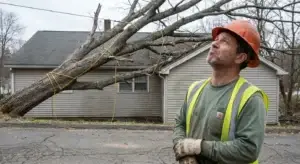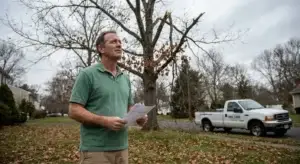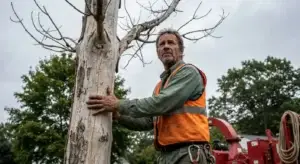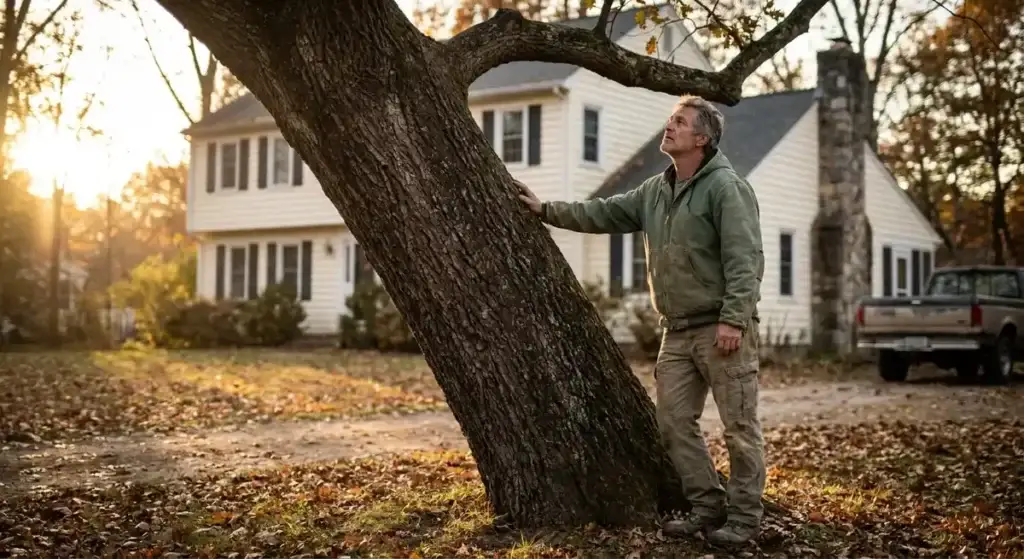
A tree leaning toward house is the kind of thing you notice one morning with your coffee and then can’t stop thinking about. Maybe it’s always leaned a little. Maybe last week’s nor’easter pushed it a few more degrees. Either way, you’re standing in the driveway wondering if you’re overreacting or if you should be moving the cars out from under it right now.
I’m Matt Webb. I run Webb Tree Services out of Canton, and I’ve walked hundreds of Connecticut properties looking at exactly this problem. Some of those leaning trees were fine and had been leaning that way for 40 years. Others came down within a week of me looking at them. The difference between the two is not obvious to a homeowner, but there are specific signs you can look for today, before you spend money on anyone coming out.
Old Lean vs. New Lean: The First Question Every Arborist Asks
The single most important thing to figure out with a tree leaning toward house is whether the lean is old or new. Trees that have grown at an angle for decades have adapted to it. Their root systems developed to counterbalance the weight. The wood on the underside of the lean grew denser (that’s called reaction wood in hardwoods, or compression wood in conifers). These trees are usually stable, and unless something else is wrong, they can stay that way for years.
A new lean is a different animal. New lean means the tree was standing upright and something moved it. Roots failed. Soil shifted. A storm loosened it. When that happens, the tree has none of the structural adaptations that make an old lean stable, and gravity is now working against a tree that’s not built to handle it.
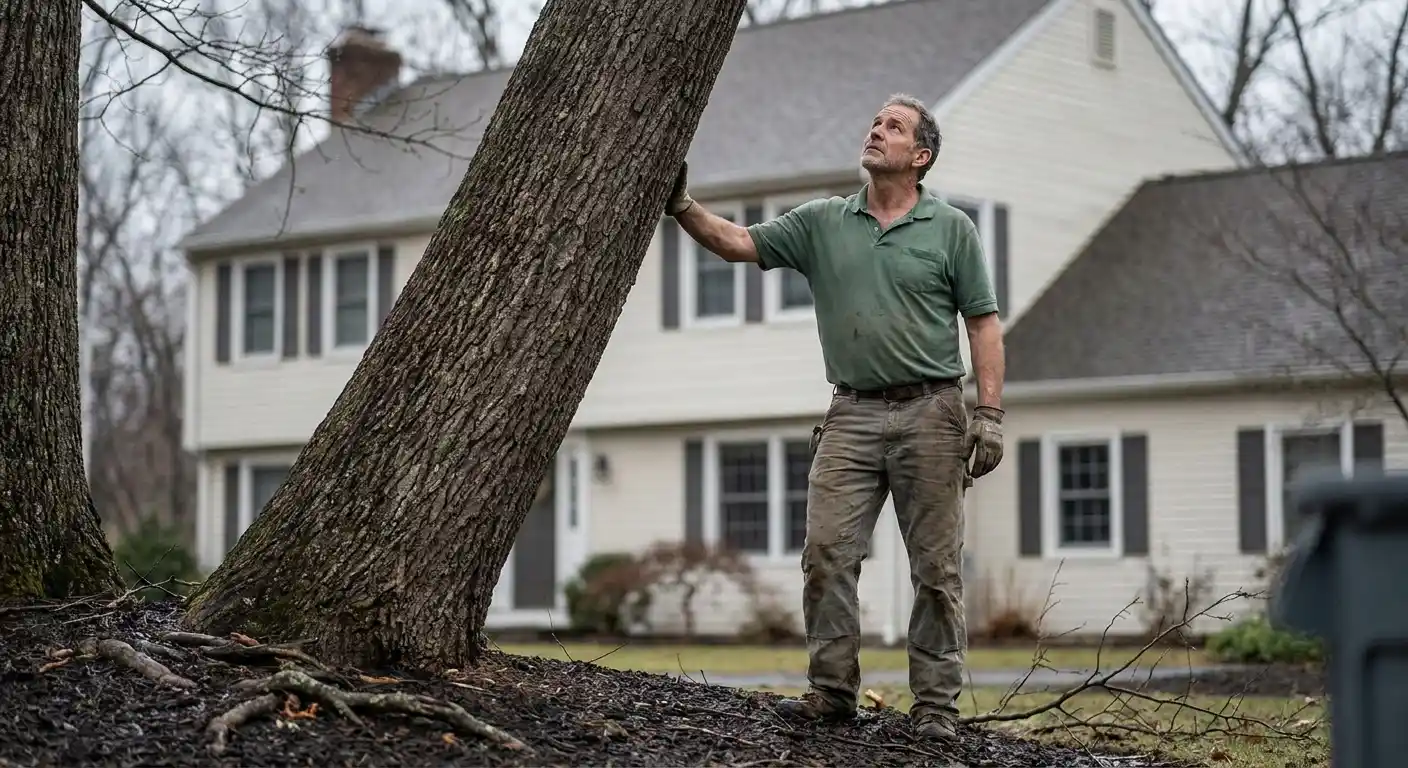
Here’s how to tell them apart. Look at the trunk where it meets the ground. On an old lean, the trunk usually curves upward toward vertical, because the tree spent years trying to grow back toward the sun. You’ll see a bend, sometimes dramatic, in the lower six to ten feet. On a new lean, the trunk is straight from top to bottom. The whole thing is tilted like a telephone pole someone pushed on.
The Four Warning Signs You Can Check Today
Before you call anyone about a tree leaning toward house, walk around it and look for these four things. You don’t need equipment. You need daylight and a willingness to look closely.
1. Heaving Soil or Cracked Ground on the Far Side
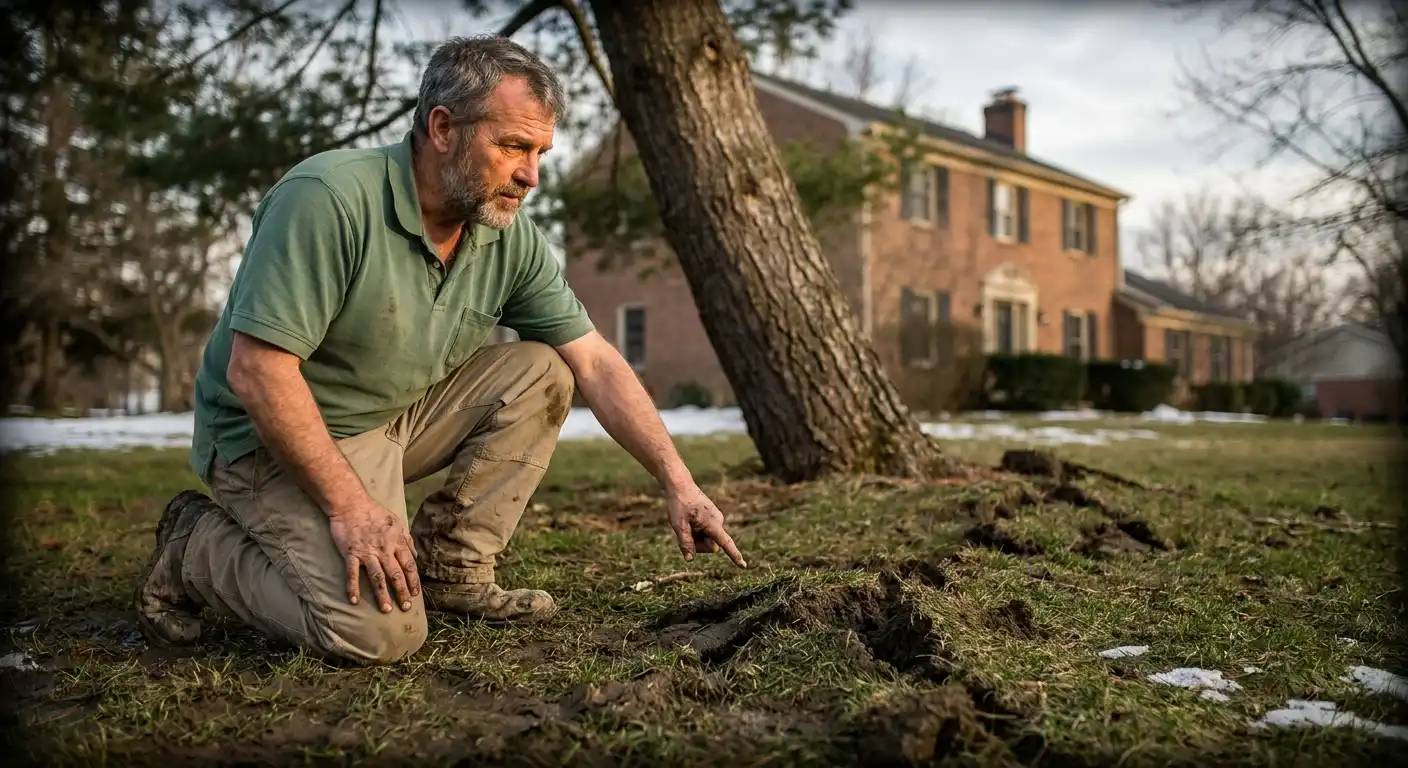
Stand on the side of the tree opposite the lean. Look at the ground. If you see a slight mound, a raised ridge of soil, or cracks in the dirt following an arc around the trunk, the root plate is lifting. This is the biggest red flag in the arborist’s playbook. When roots on the tension side start to fail, the whole root ball rotates as the tree tips, and the soil on the opposite side gets pushed up as the plate levers.
It shows up most often on white pines after a wet spring and on oaks after an ice storm. If you see soil heaving, don’t wait. That tree is already moving.
2. Exposed or Cracked Roots
Now walk to the side the tree is leaning toward. Look at the base. Are roots exposed that used to be covered? Do you see cracks running through the surface roots? Roots that look torn, split, or have soil pulling away from them are roots that are failing. In Connecticut we deal with a lot of shallow-rooted species (Norway maples, willows, silver maples, and older white pines especially) and their root systems don’t have the depth to handle a shifting load.
3. Cracks, Cavities, or Fungal Growth on the Trunk
Walk the trunk from the ground up as high as you can see. Vertical cracks that run more than a few feet, especially on the compression side (the side the tree is leaning toward), are a sign the wood is failing under its own weight. Cavities, hollows, or soft spots mean interior decay. Mushrooms or shelf fungi growing on the trunk or at the base almost always mean the wood inside is compromised, sometimes severely, even if the outside looks fine.
A tree can look healthy from 40 feet away and be hollow enough to fold in half in a windstorm. If you’re seeing any of these signs on a tree that’s already leaning toward your house, treat it as urgent.
4. Dead Branches in the Crown
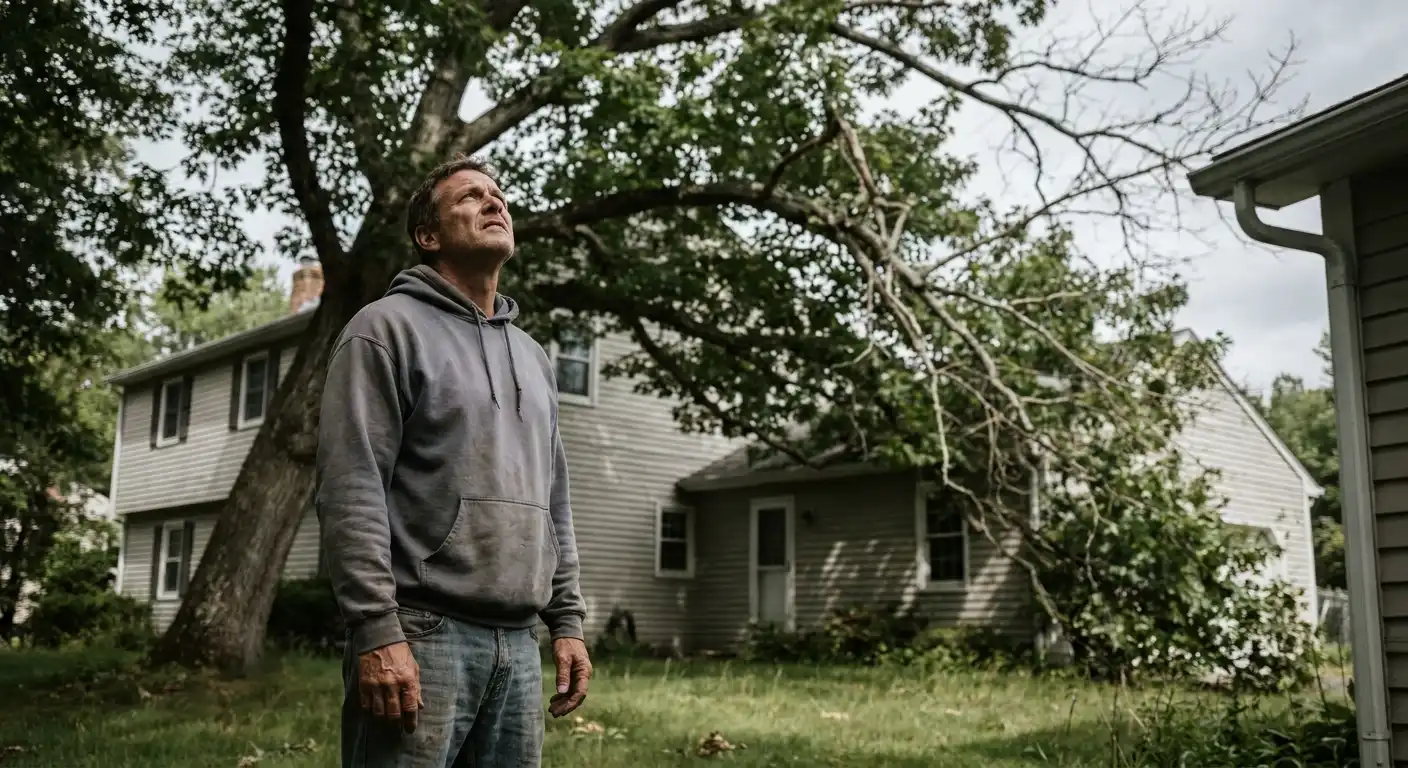
Look up. What percentage of the crown is dead? A few dead branches on a mature tree is normal, especially at the interior. But if more than about 25 percent of the canopy is dead, or if you’re seeing large dead limbs on the leaning side, the tree is in decline. A declining tree that’s also leaning is a tree with two problems compounding each other, and neither one is going to fix itself.
What to Do Right Now
If you found any one of the four warning signs above, do three things today.
First, move anything of value out from under the tree. Cars, grills, patio furniture, kids’ play structures, anything the tree could hit if it came down. If the tree is over a bedroom, sleep in a different room until you have an arborist’s assessment.
Second, take photos. Take one from each side of the tree, one straight up the trunk, and one close-up of anything concerning (heaving soil, cracks, exposed roots, fungus). These photos are how a good tree service scopes the job before they even show up. It saves you time and gets you a more accurate quote.
Third, don’t try to “help” the tree. Do not have a landscaper cable it, prop it, or top it. Cabling a compromised tree can accelerate the failure. Topping (cutting the top out to reduce weight) sounds logical but actually makes the tree more dangerous by triggering weak regrowth and stressing the remaining structure. These are decisions for a trained arborist, not general contractors.
When to Call a Certified Arborist
Not every leaning tree needs to come down. That’s the honest answer. Some leans are decades old, the tree is healthy, the root system is stable, and the right move is to leave it alone and monitor it. Other trees look fine from the street and are three weeks from failure. You cannot make that call from photos on the internet. You need someone on the property who knows what to look at.
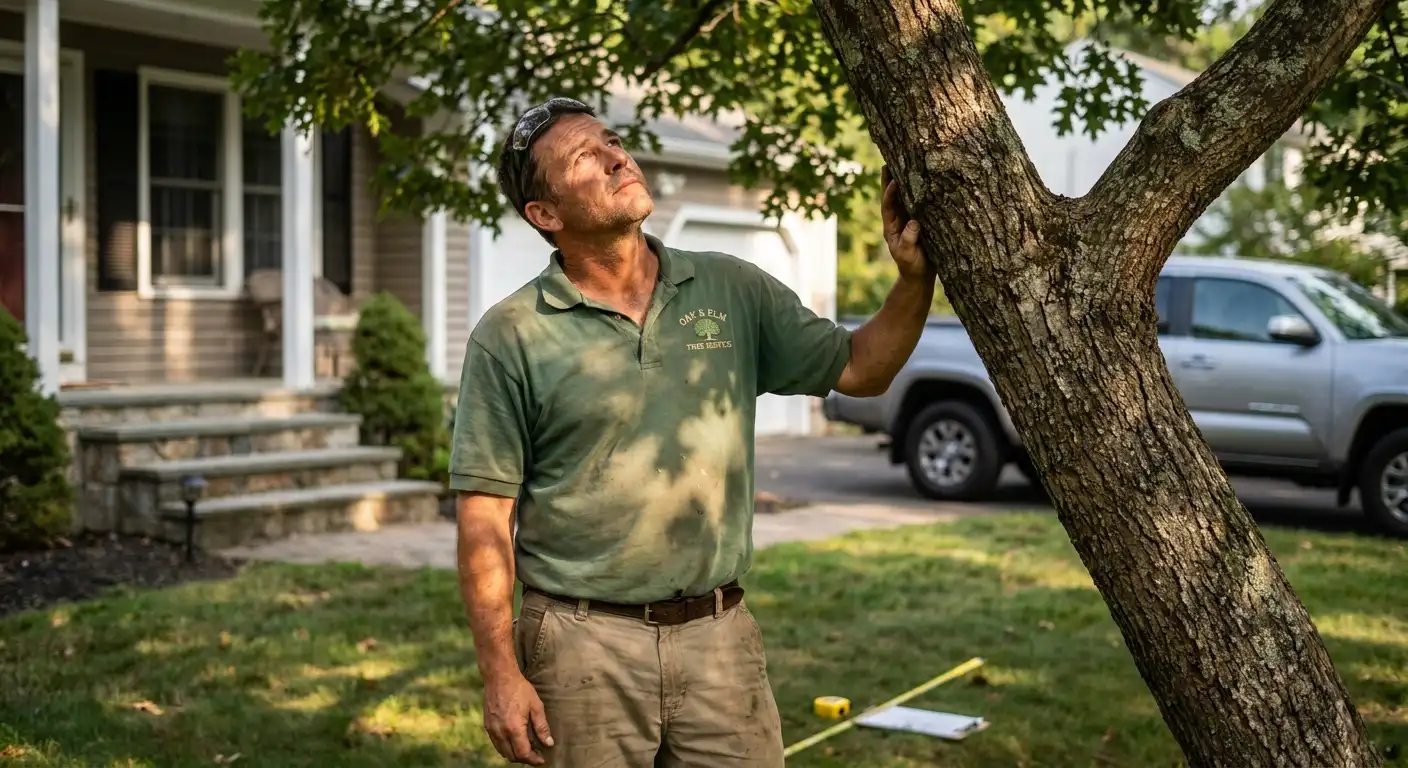
What separates a real arborist from a guy with a chainsaw is training. I hold a degree in Arboriculture and Landscape Management from Paul Smith College, which means I was taught tree biology, biomechanics, soil science, and how to read structural failure before I ever ran a saw. That’s the person you want walking your property when your house is 15 feet from a 60-foot oak.
Beyond training, ask whether they own their equipment (renting a crane means renting the schedule too), whether they carry real insurance (we run $2 million in liability plus workers comp), and whether they’ll haul the debris off or leave you with a pile. Those three answers separate a professional operation from a weekend crew.
For a broader view on how tree failure happens and what makes trees hazardous, the International Society of Arboriculture’s guidance on recognizing tree risk is written for homeowners and worth reading before you make a decision.
What a Site Assessment Actually Looks Like
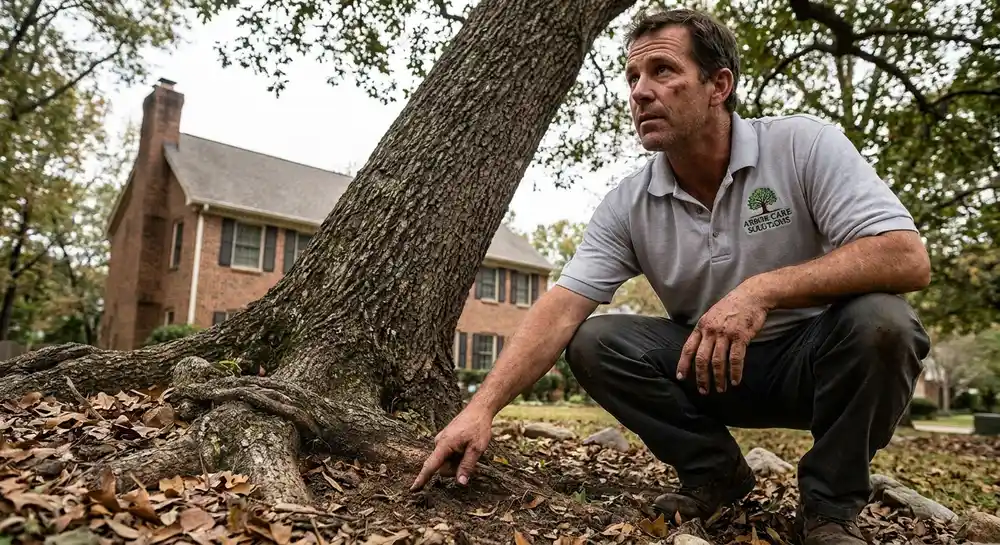
When I come out to look at a tree leaning toward house, here’s what happens. I walk the whole tree, both sides. I look at the base, the root flare, the soil around the drip line. I assess the trunk from the ground up, checking for the signs above plus a dozen more (included bark, codominant stems, response growth patterns, insect activity). I look at the crown for dieback, weak unions, and past storm damage. Then I look at what’s under the tree, meaning the house, the driveway, the power lines, the neighbor’s fence.
Based on that, I tell you one of three things. The tree is stable, keep an eye on it, here’s what to watch for. The tree needs work but not removal (targeted pruning, weight reduction, structural cabling done correctly). Or the tree needs to come down, and here’s how we do it safely with a crane if needed. That last one matters because when the tree is 15 feet from your house, you don’t fell it and hope. You lift the pieces off with a crane, one at a time, and set them in the driveway. That’s what we do on hazardous removals, and it’s why we own our own crane instead of renting when a job comes up. If you want to see more of how we approach this work, you can read about our background and approach.
Free Estimate for Connecticut Homeowners
If you have a tree leaning toward house and you want a straight answer from someone who was trained to give one, the estimate is free. I cover Hartford County and Litchfield County, from Canton and Avon to Torrington and New Milford. Text photos to (860) 839-2760 or call and we’ll get on your property this week. If it’s an emergency (tree already down, tree actively moving, tree on the house) we run 24/7 and a real human answers the phone.
You don’t have to guess whether the tree is safe. Get eyes on it and know for sure.